Getting a quality backlink is only half the battle. The other half is making it work for you long-term.
When the cost of placement on Tier-1 sites reaches hundreds of dollars, a negligent attitude toward existing links results in direct financial losses. “Link rot,” silent attribute changes to nofollow, indexation “swings,” and sudden toxic runs from competitors can nullify months of outreach before you even notice a drop in traffic.
Let’s break down how to build a simple but ironclad backlink management system that will save your time and budget.
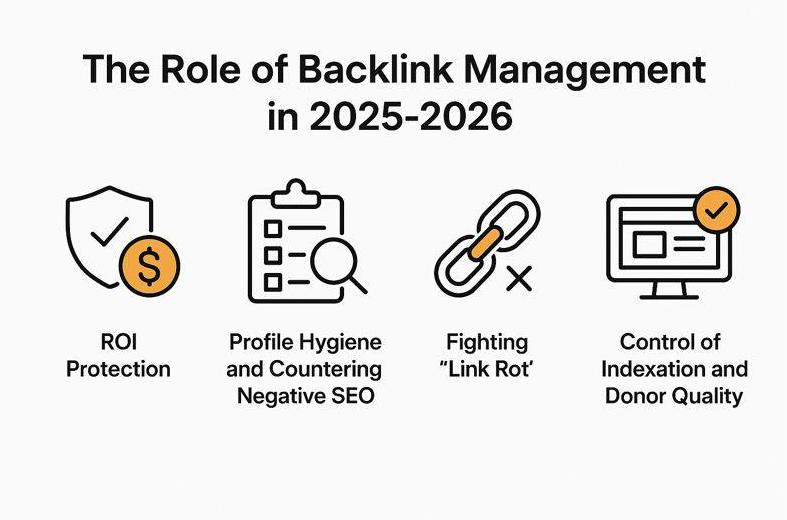
The Role of Backlink Management in 2025-2026
In 2025-2026, the SEO paradigm finally shifted from “hunting for new links” to “managing a portfolio of link assets.” Why did this happen? Because Google has become smarter, competition more aggressive, and budgets tighter.
Backlinks management today performs four critical functions, the ignorance of which makes link building a “leaky bucket.”
1. ROI Protection
The average cost of a quality outreach link continues to grow. If you paid $200 for a placement, and three months later the donor page returns a 404 error or the webmaster quietly removed your link, you have lost money. The role of a link building manager is to detect such cases promptly. In 30–40% of situations, a polite email to the webmaster restores the link for free, but without monitoring, you simply won’t know that the asset is lost.
2. Profile Hygiene and Countering Negative SEO
Google algorithms (like SpamBrain) work in real-time. Competitors can order a “run” of thousands of spam links from porn sites or doorways to your site to provoke sanctions. The role of back link management is to detect toxic activity in a timely manner and work with the Disavow file. This is your insurance against sudden loss of positions due to someone else’s manipulations.
3. Fighting “Link Rot”
The Internet is unstable. Sites change URL structures, close down, or change content. Studies show that a link profile naturally “rots” at a rate of 5–10% per year. Therefore, the role of management is to detect and fix broken redirects and redirect chains that “eat up” link weight.
4. Control of Indexation and Donor Quality
A placed link does not equal a working link. Google saves crawl budget much more strictly, so your link may drop out of the index, or the donor page may lose traffic and become ineffective. The role of management is to track the indexation status of purchased links. If a donor has “died” or fallen under a filter, it is better to disavow the link so as not to drag your site to the bottom.
What Is Backlink Management?
Backlink Management is the cyclical monitoring, analysis, and optimization of the entire array of inbound links (both paid and organic) throughout their entire lifecycle.
The three pillars of backlink management:
- Technical Monitoring. You must know what is happening with your links 24/7. Does the link exist physically? Did the webmaster change the attribute from dofollow to nofollow, sponsored, or ugc without warning? Is the agreed anchor text preserved? Does Google see the donor page right now?
- Donor Quality Assessment in Dynamics. A site that was an ideal donor a year ago may fall under a filter today or turn into a link farm. It is worth regularly checking the donor’s traffic dynamics (were there sharp drops?) and monitoring the growth of the number of outbound links on the placement page.
- Reactive Actions. This is work to fix problems. For example, emailing the webmaster if the page fell into 404 or the link disappeared; fixing redirects if you changed your site structure — old backlinks may lead to a 404 or through a chain of 301 redirects, and your task is to set up direct redirects or ask the donor to update the URL; removing toxic links that appeared naturally or as a result of a competitor’s attack.
Important distinction: If Link Building focuses on quantity and novelty, then SEO link management focuses on the quality, stability, and ROI of the already existing profile. Understanding What are natural backlinks vs. paid ones is crucial here, as natural links require different monitoring approaches than paid placements.
Why It Matters: SEO Impact of Good vs Bad Backlink Management
The difference between a managed and a chaotic link profile is measured in specific positions, traffic, and, ultimately, money. Let’s look at two scenarios.
Scenario 1: Lack of Management
You are actively building new links but not watching what happens to the old ones. You pour budget into new links, but the overall site weight does not grow or grows slowly because old links fall off or lose indexation. Your efforts go to compensating for losses, not growth.
Furthermore, spam links (from scrapers, doorways, or competitor attacks) accumulate in the background. At the moment of the next Spam Update, the site sharply loses 30-50% of traffic, and you spend months on diagnostics and exiting the filter. This lack of oversight is one of the top 5 link-building mistakes businesses make.
When redesigning or changing the URL structure of your site, old powerful backlinks begin to lead to 404 pages. Valuable link weight simply disappears into nowhere instead of ranking your content.
Scenario 2: Systemic Control
You have implemented regular monitoring and profile hygiene using a backlink manager. Each new link is added to a stable base of preserved old ones. Domain Authority (DR/DA) grows smoothly and, most importantly, predictably.
If you notice that a donor “accidentally” removed your link 3 months after payment, a reminder email will help return it. Also, with systemic monitoring, you spot a competitor’s attack in the bud and add toxic domains to the Disavow File before Google recalculates ratings.
Key Metrics & Signals You Must Monitor
We can highlight five signals that require an immediate reaction when you learn how to manage backlinks effectively.
- HTTP Status of the Donor Page
Normal: 200 OK.
Time to worry:
- 404 Not Found: The page is deleted, and you need to write to the webmaster or make a 301 redirect if the link led to your deleted page.
- 301/302 Redirect: Check if the page with your link was redirected to another resource where your link no longer exists.
- 5xx Server Error: The donor site is “down,” and if this lasts more than a week, your link is lost.
- Indexation Status
The most insidious metric. A page may physically exist (code 200) but be excluded from the Google index. This is important because a non-indexed link passes zero weight.
What to look for: The noindex tag in the donor page code or blocking in robots.txt. Webmasters often do this by mistake during technical work.
- Link Attribute Changes
You paid for dofollow but got a dummy. A sudden change of attribute from dofollow to nofollow, sponsored, or ugc. If this was a paid placement, it is a breach of agreements. It is necessary to demand attribute restoration or a refund/replacement.
- Organic Traffic of the Page/Domain
Links from “dead” sites (even with high DR) are toxic. If a sharp drop in donor traffic to zero is observed, this may indicate that the site fell under HCU (Helpful Content Update) or another filter. If the site is banned by Google, it is better to add the link from it to the Disavow file so that the “infection” does not spread to you.
- Number of Outbound Links
When you placed it, there were 2 links in the article. A month later you check — and there are already 50 links to casinos, essays, and crypto. Risk: The page has turned into a link farm. The weight of your link is diluted to microscopic values, and the neighborhood becomes dangerous.
How to Choose a Backlink Management Tool or Platform
The market offers two fundamentally different types of solutions: SaaS monitoring (programs that simply notify about problems) and Managed Platforms (services that take responsibility for the life of the link).
To choose correctly, rely on these 4 criteria:
1. Solution Type: Software vs. Service
This is the first question you must ask yourself: “Do I want a tool to do the work myself, or do I want to delegate this work?”
SaaS trackers (e.g., Linkody, Monitor Backlinks) are ideal if you have an in-house team using backlink management software. The software will show that the link disappeared, but you will have to restore it yourself (write emails, argue with webmasters).
Complex Link Building Platforms. This is the choice for those who value a “turnkey” result. For example, Links-Stream is not only a database of sites but also a service that takes on the function of backlink management. If you decide to buy relevant backlinks through them, you do not need separate backlink monitoring tools for these links — the platform team tracks their status themselves and replaces links if they disappear or are closed from indexation during the warranty period. This relieves you of the headache of “profile hygiene.”
2. Frequency and Depth of Checks
Many tools check links once a month, however, this may be too infrequent. Look for tools that check at least weekly (and preferably daily for critically important links). It is important that the tool should see not just the response code (200 OK) but also check for the presence of the noindex tag in HTTP headers and the donor’s robots.txt.
3. Metrics Integration
The link itself says nothing. You need to see the context. A good backlink management tool pulls data from Ahrefs, Moz, or Majestic (DR, DA, TF/CF) directly into the dashboard. This makes it possible to see the dynamics: has the donor lost authority since the placement? Integration with Google Search Console is also critical to see which links Google has already counted and which it ignores.
4. Teamwork Functionality
If more than one person works with links, you will need the ability to leave comments, for example, “Emailed webmaster on 05.12,” “Awaiting restoration,” assign statuses, and filter links by projects/clients.
If you have a limited budget and buy links externally, use strategies to earn free backlinks easily or choose reliable providers like Links-Stream that include monitoring in the service cost. This is cheaper than buying links separately and paying for expensive software to control them.
Top Tools & Platforms for Backlink Management in 2025-2026
We have divided them into three groups: analytics giants, specialized trackers, and service platforms.
Analytics Giants are the best option for competitor analysis and understanding the big picture. They are often considered the best tools to find link partners.
Ahrefs has the greatest popularity. It has the largest link index in the world. Reports “Lost Links” and “New Links” are the standard in the niche. The Link Intersect function makes it possible to see who links to competitors but not to you, which is useful for profile expansion.
Semrush is also at the top, as it has the Backlink Audit tool — the best on the market for fighting toxicity. It automatically marks dangerous links and helps form a Disavow file in minutes. It integrates with email, so you can write to the site owner with a request to remove the link directly from the Semrush interface.
Among Specialized Trackers, we can highlight Monitor Backlinks / Linkody — you upload a list of your donors, and the system pings them daily. If a link drops off or changes status to nofollow, you will learn about this from an email notification. These act as a dedicated backlinks manager.
Service Platforms combine purchasing and warranty service. For example, using the Links-Stream service, you automatically receive a management service. You do not need to check the status of links yourself — the system does it for you. If the backlink manager tool fixes a link removal, the team independently contacts the webmaster for restoration or offers an equivalent replacement.
Google Search Console is an absolute must-have for any specialist, as it demonstrates exactly which links the search engine actually considers, not just what third-party bots find. The main advantages of GSC remain full free access and the provision of the most accurate, official data on manual sanctions imposed on the site.
Common Mistakes & Pitfalls to Avoid
Many filter donors exclusively by Domain Rating (Ahrefs) or Domain Authority (Moz) — and this is the most common trap. DR/DA metrics are third-party metrics that are easily manipulated. There are thousands of sites with DR 70+ that have zero organic traffic; Google ignores such sites. Therefore, your priority #1 is traffic and relevance. A link from a live niche blog with DR 20 will provide more benefit than a link from a “dead” news aggregator with DR 80.
Next is the abuse of the Disavow Tool. Seeing a few strange links in the console, webmasters often panic and add them to the Disavow file. Google is great at independently ignoring (devaluing) most spam links; conversely, aggressive use of Disavow without urgent need can accidentally cut off useful links and collapse positions. Apply Disavow only in the case of obvious Manual Action or a massive spam attack that correlates with a drop in traffic.
Ignoring “link juice leakage” is also a common mistake. You redesign the site, change category URLs, or delete old articles that external links pointed to, and if you have not set up a 301 redirect from the old address to the new one, the inbound link hits a 404 page. A powerful backlink, for which you may have paid money, stops working instantly. Regularly check the “Best by links” report in Ahrefs and filter pages with code 404. Restore them or set up a redirect to relevant content.
Also, many blindly believe in the “eternity” of links — they bought a “permanent” link and forgot about it. In contracts (or verbal agreements), the term “permanent” often means “a year” or “as long as the site lives.” Without knowing how to manage your backlinks, you won’t notice how in 6 months your article “went” to the archive, the link became nofollow, or disappeared altogether. Use automated monitoring systems (or platforms like Links-Stream with a guarantee) to react instantly to changes.
FAQ
How often should I audit and manage my backlinks?
For small sites, a full audit once a month is sufficient. For large e-commerce projects or in highly competitive niches (iGaming, Crypto), monitoring should be weekly, and tracking the uptime of top links should be daily.
Can a backlink management tool help me recover lost links?
The tool itself will not restore the link, but it will instantly notify you of the loss. This is critical because if you write to the webmaster within a week, the chances of free restoration are 30-40%. A month later, no one will remember you.
What metrics matter most when Management backlinks?
Priority #1 is the donor’s organic traffic (is the site alive?). Next come: indexation status in Google, HTTP response code (200/404), and thematic relevance. DR/DA is only an auxiliary guideline.
How do I safely remove toxic or spammy links?
First, try writing to the site owners (although this rarely works). The main tool is the Google Disavow Tool, but use it carefully: add only obvious spam (doorways, porn, casinos) there if you see a drop in positions or received a warning about manual sanctions.
Is it better to use one tool or multiple tools for backlink management?
The ideal combination is Google Search Console (for accuracy) plus one professional tool (Ahrefs, Semrush, or a platform like Links-Stream) for analytics and market monitoring. Using 5 different services dilutes attention and budget.
When do I know my backlink profile is “healthy enough”?
Your profile is healthy if: 1) growth dynamics are smooth, without sharp jumps; 2) the majority of links are anchorless or branded; 3) donors have real traffic; 4) your site is steadily growing in positions, despite algorithm updates.